How London schools teach maths: what state and private schools use (2026)
We read the maths pages of 147 London school websites and noted every maths scheme, app, homework platform and competition they name.
By Anastasia Zhukova, founder of Deep Teaching · Websites read 26–28 November 2026
Jump to your child's stage
Two out of three state primaries name the same maths scheme
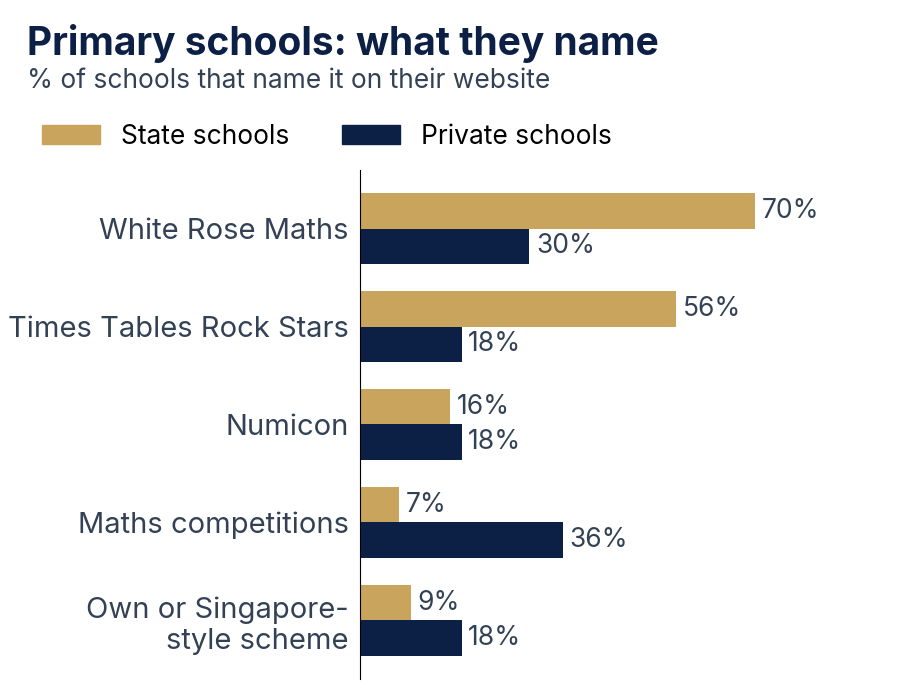
We read the maths pages of 147 London school websites, 87 state and 60 private (independent), and noted every maths scheme, app, homework platform and competition they name. Every figure is a share of schools whose website names at least one maths resource. At state primaries one name keeps coming back: White Rose Maths, a free step-by-step scheme. 70% of the state primaries name it (30 of 43). Among private prep schools it is 30% (10 of 33).
Times Tables Rock Stars, a times-tables practice app, shows the same pattern: 56% of state primaries name it, against 18% of private preps. Private preps say less about maths on their websites in general. Of the prep sites with a maths page, 53% name any scheme, app or competition, against 88% of state primaries. So when a private school's website names nothing, it often just means the school does not say.
At secondary: homework apps at state schools, competitions at private ones
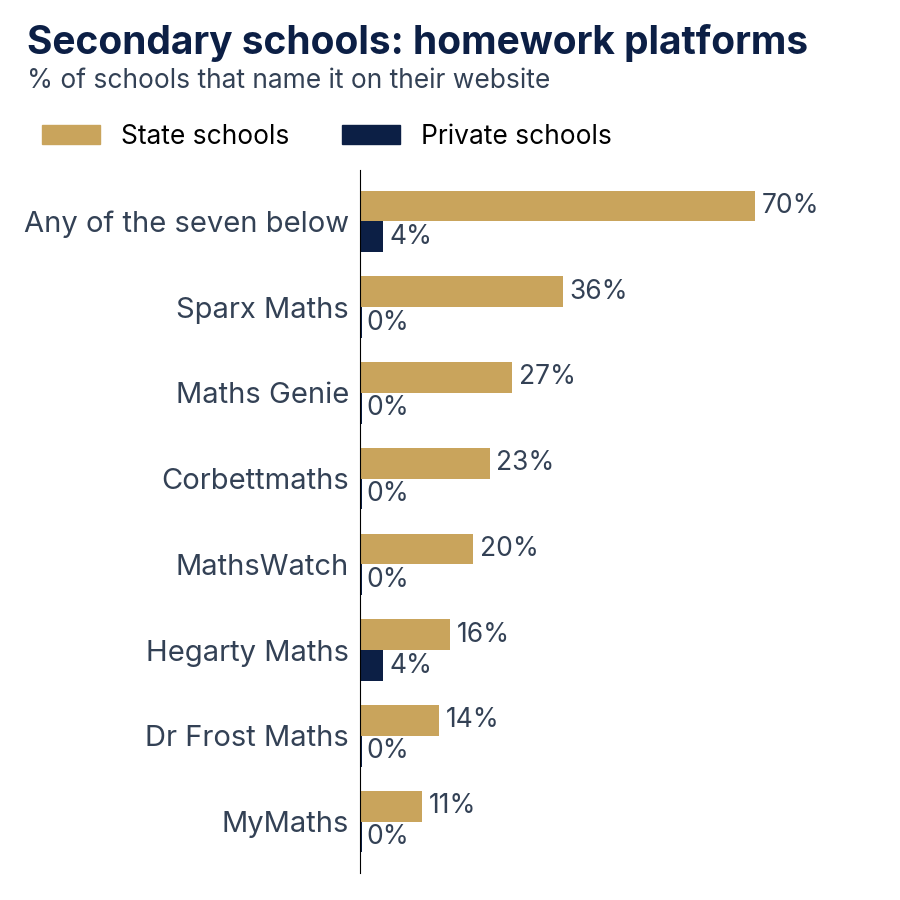
In state secondaries, maths homework mostly lives online. 70% name at least one of seven homework platforms (Sparx, Hegarty, Dr Frost, MathsWatch, MyMaths, Maths Genie or Corbettmaths), and Sparx alone is named by 36%. Among private senior schools, one school out of 27 names any of them.
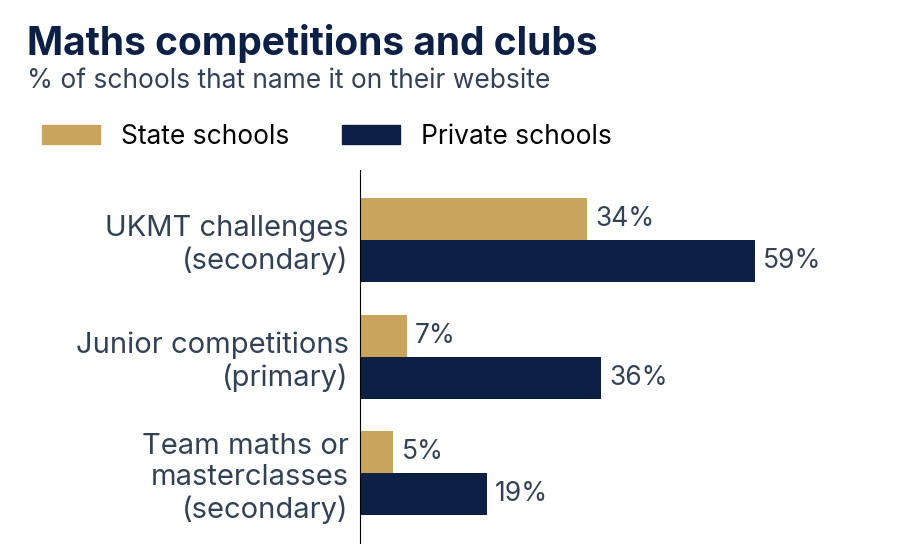
Private schools put competitions up front instead. 59% of private senior schools name the UKMT maths challenges, against 34% of state secondaries. At primary age the gap is wider: 36% of private preps name a junior competition (UKMT, the Primary Maths Challenge or Maths Kangaroo), against 7% of state primaries.
For GCSE, Edexcel is the exam board named most often in both sectors (named by 45% of state secondaries and 26% of private senior schools), followed by AQA.
The national picture
The London figures fit what is known for England as a whole. A 2023 study by the University of Brighton, funded by the Nuffield Foundation, surveyed 710 primary schools and found White Rose materials in 89% of them, NCETM materials in 79%, NRICH in 72% and Times Tables Rock Stars in 67%. Almost half the schools (46%) had no single main scheme and mixed several. White Rose itself says about 80% of English primaries use its materials.
The government's own choice was narrower. For its Teaching for Mastery programme, the Department for Education approved only two primary textbook schemes for match funding: Maths — No Problem! and Power Maths. In the same survey they were found in 22% and 10% of schools. White Rose, which is free and not a textbook, seems to have spread without that funding.
Why the difference?
Websites cannot tell us the reasons, but the context suggests a few. Most state schools follow the National Curriculum closely, and free national materials such as White Rose are built around it. State primaries also prepare children for the Year 4 times-tables check, which may explain part of the popularity of Times Tables Rock Stars.
Private schools do not have to follow the National Curriculum, and many prepare children for 11+ and 13+ entrance exams, where problem-solving and competitions are a visible sign of stretch. They also publish less about how they teach. So part of the gap is likely to be about what schools choose to show online, not only what happens in class.
What this means for your child
No scheme here is good or bad in itself: the same scheme can be taught well or badly, and a school that names nothing may still teach maths very well. What matters more is how the school uses it.
At an open day, it is worth asking: Which maths scheme do you follow, and do you use it as it is or adapt it? How do you help children who find maths hard, and stretch those who find it easy? Is homework online, how often is it set and how long should it take? Do you enter pupils for maths competitions such as the UKMT challenges?
At home, if the school uses an app such as Times Tables Rock Stars or Sparx, ask your child to show you how it works. Short, regular practice of number facts usually helps more than long sessions. Free sites that many schools name, such as NRICH for puzzles, or Corbettmaths and Maths Genie for secondary revision, cost nothing to try. And if your child is moving between a state and a private school, expect a different style rather than different maths: more structured steps and online homework on one side, more puzzles and competitions on the other.
Stage by stage
Reception–Year 2
In the first years, state schools mostly follow White Rose's small steps, with hands-on resources such as Numicon and short daily number sessions. Private schools name fewer schemes; when they do, White Rose and Times Tables Rock Stars lead here too.
Most used at state schools
- White Rose Mathsa free step-by-step scheme most state primaries follow, one small step at a time
- Times Tables Rock Starsa times-tables practice app where children race the clock and each other
- Numiconcoloured shapes with holes that show the numbers 1 to 10, so young children can see and handle numbers
- Mastering Numbera national programme of short daily number sessions for the youngest year groups
- Power Mathsa textbook scheme from Pearson, one of two the government approved for mastery funding
Most used at private schools
- White Rose Mathsa free step-by-step scheme most state primaries follow, one small step at a time
- Numiconcoloured shapes with holes that show the numbers 1 to 10, so young children can see and handle numbers
- Times Tables Rock Starsa times-tables practice app where children race the clock and each other
- Primary Maths Challengea multiple-choice puzzle competition for upper primary pupils
- The school's own schemethe school says it wrote its own maths scheme
Years 3–6
This is where the two sectors split. State primaries keep White Rose and add Times Tables Rock Stars ahead of the Year 4 times-tables check. Private preps talk more about competitions and stretch, and some about 11+ preparation.
Most used at state schools
- White Rose Mathsa free step-by-step scheme most state primaries follow, one small step at a time
- Times Tables Rock Starsa times-tables practice app where children race the clock and each other
- NRICHfree maths puzzles and problem-solving activities from the University of Cambridge
- Numbotsa game-style app for early adding and taking away, from the makers of Times Tables Rock Stars
- Numiconcoloured shapes with holes that show the numbers 1 to 10, so young children can see and handle numbers
Most used at private schools
- UKMT Maths Challengesnational puzzle-style maths competitions run by the UK Mathematics Trust
- White Rose Mathsa free step-by-step scheme most state primaries follow, one small step at a time
- Primary Maths Challengea multiple-choice puzzle competition for upper primary pupils
- Times Tables Rock Starsa times-tables practice app where children race the clock and each other
- Maths Kangarooa puzzle-style maths competition taken by pupils in many countries
Years 7–9
At state secondaries homework moves online, with platforms such as Sparx, Maths Genie and MathsWatch, and many schools also enter the UKMT challenges. Private schools name competitions and maths clubs, and almost never a homework platform.
Most used at state schools
- UKMT Maths Challengesnational puzzle-style maths competitions run by the UK Mathematics Trust
- Sparx Mathsan online homework platform that sets each pupil their own weekly questions
- Maths Geniea free revision website with GCSE past papers and videos
- MathsWatchan online platform of short videos and questions for GCSE maths
- Corbettmathsfree videos, worksheets and daily practice questions
Most used at private schools
- UKMT Maths Challengesnational puzzle-style maths competitions run by the UK Mathematics Trust
- Maths Feast / Team Maths Challengeteam maths competitions between schools
- Maths Kangarooa puzzle-style maths competition taken by pupils in many countries
- White Rose Mathsa free step-by-step scheme most state primaries follow, one small step at a time
- Royal Institution MasterclassesSaturday maths workshops for keen pupils
Years 10–11
The GCSE years. Edexcel is the exam board named most often in both sectors, then AQA. State schools keep their homework and revision sites; private schools keep their competitions going.
Most used at state schools
- Edexcelthe exam board that sets the school's GCSE maths papers (part of Pearson)
- Sparx Mathsan online homework platform that sets each pupil their own weekly questions
- AQAthe exam board that sets the school's GCSE maths papers
- UKMT Maths Challengesnational puzzle-style maths competitions run by the UK Mathematics Trust
- Maths Geniea free revision website with GCSE past papers and videos
Most used at private schools
- UKMT Maths Challengesnational puzzle-style maths competitions run by the UK Mathematics Trust
- Edexcelthe exam board that sets the school's GCSE maths papers (part of Pearson)
- AQAthe exam board that sets the school's GCSE maths papers
- Maths Feast / Team Maths Challengeteam maths competitions between schools
- White Rose Mathsa free step-by-step scheme most state primaries follow, one small step at a time
Where the data comes from
- We picked state and private London schools at random from our database, in every borough, and read the maths pages, curriculum pages and maths PDFs on their own websites (26–28 November 2026). 147 schools named at least one maths scheme, app, platform or competition: these are the schools counted.
- We noted every maths scheme, textbook, app, homework platform, exam board and competition each school names, and the school years it applies to.
- For every stage we counted how many schools in each group name each one. The lists show the five named most often.
See all 147 schools we used
State schools (87)
- Ada Lovelace Church of England High School (Ealing) · State secondary
- Al-Noor Voluntary Aided Muslim Primary School (Redbridge) · State primary
- All Saints Carshalton Church of England Primary School (Sutton) · State primary
- Ashmole Academy (Barnet) · State secondary
- Ashmole Primary School (Lambeth) · State primary
- Barnehurst Junior School (Bexley) · State primary
- Beatrix Potter Primary School (Wandsworth) · State primary
- Beths Grammar School (Bexley) · State secondary
- Bobby Moore Academy (Newham) · State secondary
- Bond Primary School (Merton) · State primary
- Castle Hill Primary School (Kingston upon Thames) · State primary
- Chingford Foundation School (Waltham Forest) · State secondary
- Dagenham Park Church of England School (Barking and Dagenham) · State secondary
- Dormers Wells High School (Ealing) · State secondary
- Ernest Bevin Academy (Wandsworth) · State secondary
- Field End Junior School (Hillingdon) · State primary
- Frances Bardsley Academy for Girls (Havering) · State secondary
- Fulham Primary School (Hammersmith and Fulham) · State primary
- Gatton (VA) Primary School (Wandsworth) · State primary
- Gaynes School (Havering) · State secondary
- Glenthorne High School (Sutton) · State secondary
- Greenshaw High School (Sutton) · State secondary
- Greig City Academy (Haringey) · State secondary
- Grey Court School (Richmond upon Thames) · State secondary
- Guru Nanak Sikh Academy (Hillingdon) · State secondary
- Haberdashers' Hatcham College (Lewisham) · State secondary
- Hampton Infant School and Nursery (Richmond upon Thames) · State primary
- Harefield Academy (Hillingdon) · State secondary
- Harris Academy Beckenham (Bromley) · State secondary
- Harris Academy Bermondsey (Southwark) · State secondary
- Harris Academy Greenwich (Greenwich) · State secondary
- Harris Academy Wimbledon (Merton) · State secondary
- Harris Garrard Academy (Bexley) · State secondary
- Harris Primary Academy Crystal Palace (Bromley) · State primary
- Heathcote School, Chingford (Waltham Forest) · State secondary
- Heber Primary School (Southwark) · State primary
- Highlands School, Grange Park (Enfield) · State secondary
- Hoxton Garden Primary (Hackney) · State primary
- Hylands Primary School (Havering) · State primary
- Kingfisher Hall Primary Academy (Enfield) · State primary
- Kingsmead School, Enfield (Enfield) · State secondary
- Langley Park School for Girls (Bromley) · State secondary
- Langtons Junior Academy (Havering) · State primary
- Leigh Stationers' Primary Academy (Bexley) · State primary
- London Enterprise Academy (Tower Hamlets) · State secondary
- Meridian Primary School (Greenwich) · State primary
- Michaela Community School (Brent) · State secondary
- Millfields Community School (Hackney) · State primary
- Mulberry UTC (Tower Hamlets) · State secondary
- Orion Blenheim (Bromley) · State primary
- Park Academy West London (Hillingdon) · State secondary
- Parkhill Infants' School (Redbridge) · State primary
- Parkhill Junior School (Redbridge) · State primary
- Pelham Primary School (Merton) · State primary
- Redden Court School (Havering) · State secondary
- Rhyl Community Primary School (Camden) · State primary
- Riddlesdown Collegiate (Croydon) · State secondary
- Robert Clack School (Barking and Dagenham) · State secondary
- Robin Hood Infants' School (Sutton) · State primary
- Robin Hood Junior School (Sutton) · State primary
- Rutlish School (Merton) · State secondary
- Saint Jerome Church of England Bilingual School (Harrow) · State primary
- Sedgehill School (Lewisham) · State secondary
- Sir John Lillie Primary School (Hammersmith and Fulham) · State primary
- Southborough High School (Kingston upon Thames) · State secondary
- St Aidan's Voluntary Controlled Primary School (Haringey) · State primary
- St Augustine's Church of England High School (Westminster) · State secondary
- St George's Catholic Primary School (Enfield) · State primary
- St George's, Bickley, Church of England Primary School (Bromley) · State primary
- St Joan of Arc RC Primary School (Islington) · State primary
- St Paul's Church of England Primary School (Southwark) · State primary
- St Stephen's School (Shepherd's Bush) (Hammersmith and Fulham) · State primary
- The Kingston Academy (Kingston upon Thames) · State secondary
- The Totteridge Academy (Barnet) · State secondary
- The Urswick School (Hackney) · State secondary
- Torriano Primary School (Camden) · State primary
- Trinity Catholic High School, Woodford Green (Redbridge) · State secondary
- Turing House School (Richmond upon Thames) · State secondary
- Warrender Primary School (Hillingdon) · State primary
- Watling Park School (Barnet) · State primary
- Wellington Primary School (Tower Hamlets) · State primary
- Wessex Gardens Primary School (Barnet) · State primary
- West Drayton Academy (Hillingdon) · State primary
- Willowfield School (Waltham Forest) · State secondary
- Winterbourne Nursery and Infants' School (Croydon) · State primary
- Woodridge Primary School (Barnet) · State primary
- Wren Academy Enfield (Enfield) · State secondary
Private (independent) schools (60)
- Alleyn's Hampstead Senior School (Camden) · Private senior
- Alleyn's School (Southwark) · Private senior
- Apex Primary School (Redbridge) · Private prep
- Babington House School (Bromley) · Private senior
- Bancroft's School (Redbridge) · Private senior
- Baston House School (Bromley) · Private senior
- Belmont, Mill Hill Preparatory (Barnet) · Private prep
- Blackheath High School (Greenwich) · Private senior
- Channing Junior School (Haringey) · Private prep
- Channing School (Haringey) · Private senior
- Clifton Lodge School (Ealing) · Private prep
- Date Palm Primary (Tower Hamlets) · Private prep
- DLD College London (Lambeth) · Private senior
- Donhead Preparatory School (Merton) · Private prep
- Eastcourt Independent School (Redbridge) · Private prep
- Eaton House The Manor School (Wandsworth) · Private prep
- Eaton Square Prep (Westminster) · Private prep
- Fidelis College (Croydon) · Private senior
- Francis Holland School Sloane Square (Westminster) · Private senior
- Gatehouse School (Tower Hamlets) · Private prep
- Goodwyn School (Barnet) · Private prep
- Guildhouse School (Camden) · Private senior
- Hall School Wimbledon (Merton) · Private senior
- Hampton School (Richmond upon Thames) · Private senior
- Harmony Primary School (Harrow) · Private prep
- Heath House Preparatory School (Lewisham) · Private prep
- Herne Hill School (Southwark) · Private prep
- Hornsby House (Wandsworth) · Private prep
- Kensington Park School (Westminster) · Private senior
- Kingston Grammar School (Kingston upon Thames) · Private senior
- Knightsbridge School (Kensington and Chelsea) · Private senior
- Laleham Lea School (Croydon) · Private prep
- Latymer Upper School (Hammersmith and Fulham) · Private senior
- London East Academy (Tower Hamlets) · Private senior
- Marymount International School (Kingston upon Thames) · Private senior
- Mount House School (Barnet) · Private senior
- Newland House School (Richmond upon Thames) · Private prep
- Noor Ul Islam Primary School (Waltham Forest) · Private prep
- Pembridge Hall School (Kensington and Chelsea) · Private prep
- Prospect House (Wandsworth) · Private prep
- Quwwat Ul Islam Girls' School (Newham) · Private senior
- Rosemary Works School (Hackney) · Private prep
- Sarum Hall School (Camden) · Private prep
- St Augustine's Priory (Ealing) · Private senior
- St Catherine's School, Twickenham (Richmond upon Thames) · Private senior
- St James Preparatory School (Hammersmith and Fulham) · Private prep
- St Mary's School, Hampstead (Camden) · Private prep
- Sydenham High School (Lewisham) · Private senior
- Tarbiyyah Primary School (Hounslow) · Private prep
- The Children's House School (Islington) · Private prep
- The Complete Works (Tower Hamlets) · Private senior
- The Gower School (Islington) · Private prep
- The King Alfred School (Barnet) · Private senior
- The Mall School (Richmond upon Thames) · Private prep
- The Pointer School (Greenwich) · Private prep
- Trevor-Roberts School (Camden) · Private prep
- Vita Et Pax School (Enfield) · Private prep
- Westbury House School (Kingston upon Thames) · Private prep
- Wildwood Nature School (Camden) · Private prep
- Wimbledon High School (Merton) · Private senior
Method and limits
- Every school we used is listed under Where the data comes from. "Most used" means named most often on the schools' own websites.
- Every percentage is a share of schools whose website names at least one maths resource; schools whose sites name none are not in the counts.
- Pages dated before November 2023 were excluded where a date could be found (news posts, documents and uploads with a date or upload stamp in their address), third-party pages, job adverts, bare home pages and review-guide pages. Where a junior and a senior school share one website, each page counts only for the school it is about.
- A website shows what a school chooses to say, not everything used in class. A school that uses a scheme or app but never mentions it counts as not using it, so every figure is a minimum, not a usage rate.
- Private schools publish less about how they teach maths, which explains part of their lower figures for schemes and apps.
- Each group has between 27 and 44 schools, so one school moves a figure by 2 to 4 points. Treat gaps of less than about 15 points as noise.
- Names were matched automatically (for example, WRM = White Rose Maths) and the matches were spot-checked by hand. Some errors will remain.
- Where a page named the school years (49% of items), we used them; otherwise we used the school's age range and the usual years for that scheme or app (for example, Sparx counts for Years 7 to 11 only).
- Schools were picked at random, at most 3 per borough in each group, with extra private preps added because fewer of them publish maths details. 39 sampled websites could not be reached. Figures are not weighted by pupil numbers.
- The national figures come from the 2023 University of Brighton study (funded by the Nuffield Foundation), the NCETM and White Rose's own figure.
- The short descriptions of each scheme and app, and the notes on each stage, are our own.
How to cite
Deep Teaching (2026), “How London schools teach maths: what state and private schools use (2026)”, deepteaching.ai/research/maths-in-london-schools